
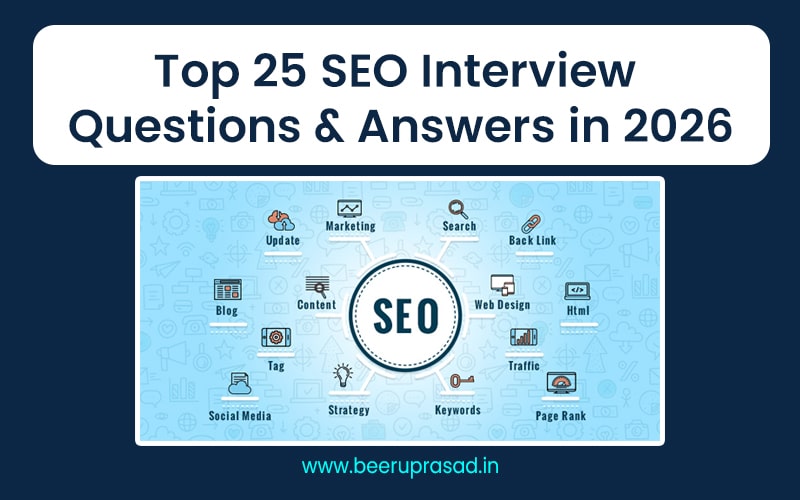
Here are the Top 25 SEO (Search Engine Optimization) Interview Questions with answers. You can read these answers and prepare yourself for the SEO job profile interview. If you want to learn SEO from Mr. Beeru Prasad then you can contact us at the given contact details.
1. What is SEO and why is it important in 2026?
Answer:
SEO (Search Engine Optimization) is the practice of improving website visibility in organic search results. In 2026, SEO is crucial because search engines now prioritize AI-driven results, SGE (Search Generative Experience) summaries, EEAT signals, and user intent, making optimized content essential for visibility.
2. What is the difference between On-Page and Off-Page SEO?
Answer:
-
On-Page SEO: Optimization done within the website (content, keywords, headings, URLs, schema, internal links).
-
Off-Page SEO: External activities (backlinks, brand mentions, PR, social signals, reputation building).
3. What is SGE (Search Generative Experience)?
Answer:
SGE is Google’s AI-powered search layer that provides AI-generated summaries. SEO in 2026 focuses on structured data, authority, and answer-focused content to appear within SGE snapshots.
4. What is EEAT in SEO?
Answer:
EEAT stands for Experience, Expertise, Authoritativeness, Trustworthiness.
Google uses EEAT to check credibility of content, authors, and websites—especially for YMYL content (finance, health, legal).
5. What are Core Web Vitals?
Answer:
A set of performance metrics:
-
LCP (Largest Contentful Paint)
-
CLS (Cumulative Layout Shift)
-
INP (Interaction to Next Paint) — replaced FID
They measure speed, stability, and interactivity.
6. What is keyword intent?
Answer:
The purpose behind a search query. Types:
-
Informational
-
Navigational
-
Transactional
-
Commercial Investigation
7. What are long-tail keywords and why are they important?
Answer:
Long, highly specific phrases that target narrow search intent. They bring high conversion, low competition, and work well for voice search and AI search.
8. What are the main ranking factors in 2026?
Answer:
-
EEAT
-
Content quality
-
Backlinks
-
Search intent match
-
Page experience (Core Web Vitals)
-
Mobile-first indexing
-
Schema markup
-
Internal link structure
-
User engagement metrics
9. What is technical SEO?
Answer:
Optimizing website structure and backend systems — crawling, indexing, site speed, XML sitemap, robots.txt, schema markup, canonical tags, and fixing errors.
10. What is Google Sandbox?
Answer:
A period where new websites do not rank immediately due to trust factors. Google observes quality signals before boosting rankings.
11. What is the difference between Crawling and Indexing?
Answer:
-
Crawling: Googlebot scans the website.
-
Indexing: Google stores the crawled pages in its database.
12. What is a canonical tag?
Answer:
A tag that prevents duplicate content by specifying the preferred version of a page.
13. What is a sitemap and why is it important?
Answer:
A sitemap is an XML file that lists important URLs for search engines to crawl and index efficiently.
14. What is robots.txt?
Answer:
A file that instructs search engine bots which pages to crawl or avoid.
15. How do backlinks affect SEO?
Answer:
Backlinks act as votes of authority. High-quality, relevant backlinks improve rankings and trust.
16. What is link building in 2026?
Answer:
Modern link building includes:
-
Digital PR
-
Thought-leadership content
-
HARO alternatives
-
Brand mentions
-
High-value partnerships
-
AI-assisted outreach
Low-quality link building is now heavily penalized.
17. How does mobile-first indexing work?
Answer:
Google uses the mobile version of your site for crawling and ranking. Responsive design is mandatory in 2026.
18. What is schema markup?
Answer:
Structured data that helps Google understand and display rich snippets such as FAQs, reviews, products, and events.
19. What is the difference between White Hat and Black Hat SEO?
Answer:
-
White Hat: Follows Google’s guidelines (quality content, genuine backlinks).
-
Black Hat: Manipulative practices (keyword stuffing, link farms) — risky and penalized.
20. How to optimize content for voice search?
Answer:
-
Use conversational phrases
-
Target long-tail questions
-
Add FAQ schema
-
Give short, direct answers
21. What tools are used in SEO?
Answer:
-
Google Search Console
-
Google Analytics 4 (GA4)
-
SEMrush
-
Ahrefs
-
Screaming Frog
-
Surfer SEO
-
GTmetrix
-
PageSpeed Insights
22. What is local SEO?
Answer:
SEO that optimizes visibility for local searches. Includes Google Business Profile optimization, NAP consistency, reviews, and local citations.
23. What causes Google Penalties?
Answer:
-
Spammy backlinks
-
AI-generated low-quality content
-
Keyword stuffing
-
Cloaking
-
Duplicate content
-
Thin content
24. What is Keyword Cannibalization?
Answer:
When multiple pages target the same keyword, causing them to compete and drop rankings.
25. How do you measure SEO success in 2026?
Answer:
-
Organic traffic
-
Conversions & leads
-
Keyword visibility
-
Click-through rate
-
Engagement
-
Backlink quality
-
SGE snapshot appearance
-
Core Web Vitals scores